






Installation of photovoltaic panels on existing flat roofs - some lessons learned IP 8 14
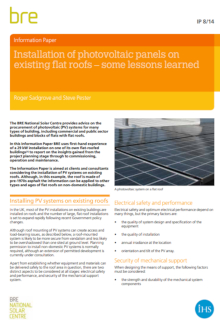
Installation of photovoltaic panels on existing flat roofs - some lessons learned (IP 8/14) was written by Roger Sadgrove and Steve Pester and published by BRE on 10 July 2014. BRE (Building Research Establishment) is an independent, research-based consultancy, testing and training organisation, operating in the built environment and associated industries.
In the UK, most of the photovoltaic (PV) installations on existing buildings are installed on roofs. Although roof mounting of PV systems can create access and load-bearing issues, a roof mounted system is likely to be secure from vandalism and less likely to be overshadowed than one sited at ground level.
Apart from establishing whether equipment and materials can be delivered safely to the roof area in question, electrical safety and performance, and security of the mechanical support system must be considered at all stages.
This 8-page information paper is intended to help make clients and consultants aware of issues involved in the installation of PV systems on traditional asphalt flat roofs of existing buildings. It sets out insights gained in carrying out the whole process from planning through to commissioning, operation and maintenance.
Its contents are:
- Installing PV systems on existing roofs.
- Securing a PV system to an asphalt roof.
- Load calculations and wind forces.
- Access limitations.
- Working at height considerations.
- Inadvertent shadowing.
- The need for a comprehensive method statement.
- Monitoring of post-installation performance.
- Maintenance.
- Government policy.
- The BRE PV installation project.
- Specification considerations.
- Assessing the robustness of the roof.
- Assessing the roof construction.
- Operational considerations.
- Working at height procedures.
- Conclusions.
- References and notes.
- Further reading.
[edit] Related articles on Designing Buildings Wiki
- Battery energy storage systems with grid-connected solar photovoltaics BR 514.
- BRE articles on Designing Buildings Wiki.
- BRE Buzz articles on Designing Buildings Wiki.
- BRE National Solar Centre.
- BRE photovoltaic certification scheme.
- BREEAM Responsible sourcing of materials.
- BREEAM.
- Building Research Establishment.
- Code of practice for grid connected solar photovoltaic systems.
- DC isolators for photovoltaic systems (FB 68).
- Flexible Solar Panels.
- Photovoltaics.
- Renewable energy sources: how they work and what they deliver: Part 4: Solar thermal hot water systems DG 532 4.
- Solar thermal systems.
Featured articles
Check out some of the best features and news from Designing Buildings as well as key stories from around the web.
The importance of early engagement
Construction lessons from the Trillium HealthWorks Experience Centre.
Mayors are to be given planning call in powers
Mayors across England will be able to make the most important planning decisions.

The Master Builder: William Butterfield and his times. Book review.
Why construction can't afford to ignore the skills gap.
Building Safety Regulator, 19 August

Gill Kernick appointed Independent Chair of Residents’ Panel.
Connecting knowledge, technology and conservation
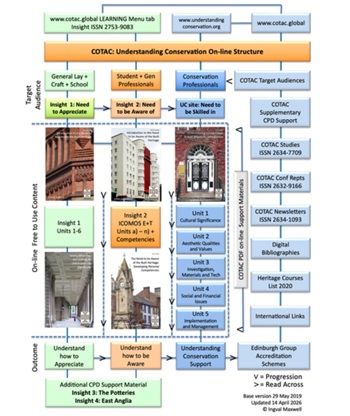
Building competence for the future of built heritage.
Building Regulations and Building Safety Act
CIOB publishes free advice for non-domestic clients.
Building Safety Newsletter from MHCLG.
An extraordinary record of steel engineering worldwide.
Households living near new pylons to save on bills.

ECA warns growth must not outpace grid capacity or skills.
The role of the client and decision making

CIOB response to built environment professions call for evidence.